
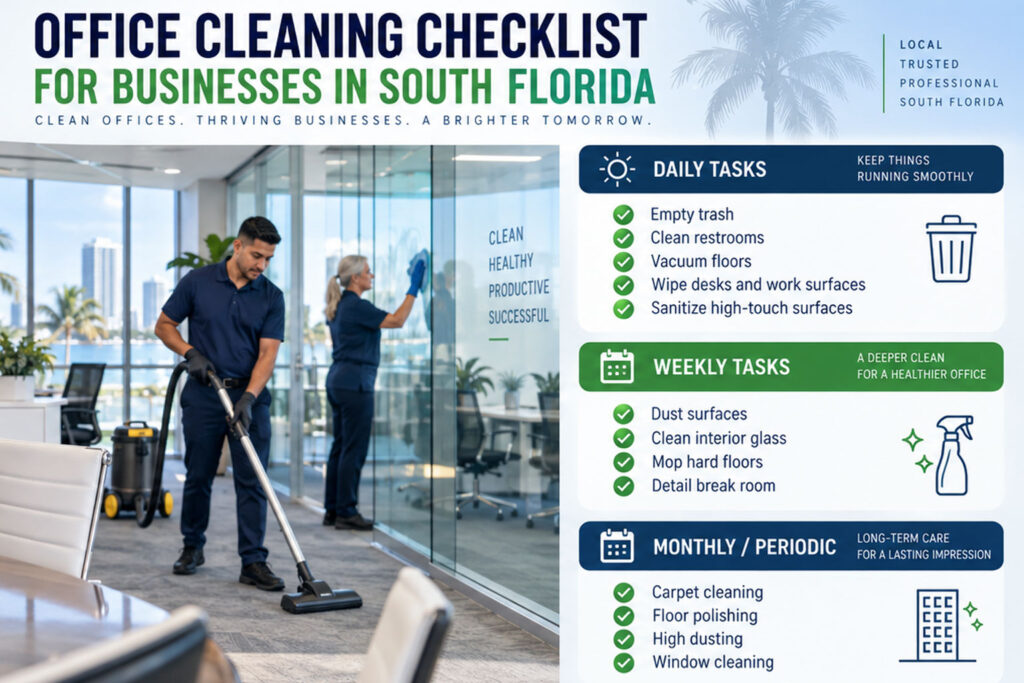
Office Cleaning Checklist for Businesses
A professional office cleaning checklist should cover the areas employees, customers, and visitors use every day, including entrances, workspaces, conference rooms, break rooms, restrooms, floors, and shared surfaces. The exact tasks and cleaning frequency should be customized according to the office’s size, occupancy, visitor traffic, flooring, operating hours, and how each space is used.
This office cleaning checklist provides businesses and facility managers with a practical framework for developing a consistent cleaning program. It covers daily and recurring cleaning tasks, high-touch surfaces, restrooms, common areas, flooring, and periodic deep cleaning so businesses can identify what their facility may need. For a broader overview of professional cleaning programs, see our Ultimate Guide to Commercial Cleaning Services in South Florida.
What Should Be Included in an Office Cleaning Checklist?
An effective office cleaning checklist should account for the entire facility rather than focusing only on visible areas such as floors and desks. Professional office building cleaning services should be structured around the way employees, customers, and visitors actually use the property.
A typical commercial office cleaning program may include:
- Entrances and reception areas
- Individual offices and workstations
- Conference and meeting rooms
- Break rooms and kitchens
- Restrooms
- Hallways and common areas
- Floors and carpeting
- Trash and recycling
- High-touch surfaces
- Interior glass
- Periodic deep cleaning
Not every task needs to be completed every day. The goal is to establish an appropriate frequency for each area based on how frequently it is used and the level of traffic it receives.
Daily Office Cleaning Checklist
Daily cleaning focuses on the areas and tasks that can quickly affect the cleanliness, appearance, and usability of an office.
High-traffic offices may require all of these tasks every business day, while smaller or lightly occupied offices may use a different schedule. Businesses that need ongoing routine maintenance can incorporate these tasks into a recurring janitorial cleaning service.
Entrances and Reception Areas
- Remove visible dirt and debris from entrance areas
- Vacuum entrance mats and carpeted areas as needed
- Sweep and mop hard-surface flooring
- Clean entrance-door glass
- Clean reception counters and approved surfaces
- Empty trash receptacles
- Clean frequently touched door handles and surfaces
- Return furniture and reception areas to an orderly appearance
The entrance and reception area create one of the first impressions customers, clients, applicants, vendors, and other visitors have of a business. These areas generally deserve more frequent attention than spaces with limited traffic.
Office and Workstation Areas
- Empty trash and recycling containers
- Replace liners when necessary
- Vacuum carpeted traffic areas
- Sweep or mop hard flooring as appropriate
- Dust accessible approved surfaces
- Clean common touchpoints
- Remove visible debris
- Spot-clean glass and other approved surfaces as needed
Cleaning personnel should understand which desks, electronics, paperwork, and personal work areas they are authorized to clean. Businesses should define these expectations in the cleaning scope so important documents, equipment, and employee belongings are not unnecessarily disturbed.
Conference and Meeting Rooms
- Empty waste containers
- Clean conference tables
- Wipe approved shared surfaces
- Clean door handles and other frequently touched areas
- Vacuum or clean flooring
- Spot-clean interior glass
- Return chairs to an orderly position
- Remove visible debris following meetings
Conference rooms may experience periods of limited use followed by several meetings in a single day. Their cleaning frequency should reflect actual usage rather than simply following the same schedule as every other room.
Break Rooms and Office Kitchens
- Empty trash and recycling
- Clean countertops
- Wipe tables and approved surfaces
- Clean sinks and fixtures
- Clean exterior appliance surfaces
- Spot-clean cabinet fronts when necessary
- Sweep and mop flooring
- Clean high-touch surfaces
- Remove visible food residue from approved areas
Break rooms typically need consistent attention because food, beverages, waste, and frequent employee traffic can cause these spaces to become dirty faster than standard work areas.
Restrooms
- Clean and disinfect toilets and urinals
- Clean sinks and fixtures
- Clean counters
- Clean mirrors
- Empty waste containers
- Replace liners as necessary
- Restock approved restroom supplies
- Clean high-touch surfaces
- Sweep and mop floors
- Check for visible soil, spills, or other issues requiring attention
Restrooms are among the most important areas of an office cleaning program. The appropriate cleaning frequency depends heavily on the number of employees and visitors using the facility. Larger and heavily trafficked offices may require restroom attention multiple times during the business day rather than once each evening.
Common Areas and Hallways
- Remove trash and visible debris
- Vacuum carpeted areas
- Sweep and mop hard flooring
- Clean high-touch surfaces
- Spot-clean walls, doors, and glass as necessary
- Maintain seating and shared spaces
Common areas often receive substantially more traffic than individual offices and should be evaluated accordingly when determining cleaning frequency.
High-Touch Surfaces That Should Receive Regular Attention
Some surfaces are touched repeatedly throughout the workday by multiple people. Including these areas in the cleaning scope helps prevent them from being overlooked simply because they don’t appear visibly dirty.
Common high-touch surfaces in offices include:
- Door handles
- Push plates
- Light switches
- Elevator buttons
- Shared appliance handles
- Break room fixtures
- Conference room equipment
- Shared counters
- Reception surfaces
- Restroom fixtures
- Handrails
- Shared touchscreens and controls, when approved for cleaning
The type of surface and equipment should determine which cleaning products and procedures are appropriate. Electronics and specialty surfaces, for example, may require different procedures from standard hard surfaces. Facilities that require more detailed periodic service can also incorporate deep cleaning and disinfecting services into their overall cleaning program.
Office Floor Cleaning Checklist
Office flooring can account for a substantial portion of a facility’s visible appearance and maintenance requirements.
Dirt, sand, moisture, and debris enter through building entrances and gradually move into hallways, offices, conference rooms, and common spaces.
Carpeted Floors
Routine carpet maintenance can include:
- Vacuuming high-traffic areas
- Vacuuming lower-traffic areas according to schedule
- Spot-cleaning spills and stains when appropriate
- Cleaning edges and corners periodically
- Scheduling deeper carpet cleaning as needed
Hard-Surface Floors
Depending on the flooring material, routine care may include:
- Dust mopping or sweeping
- Wet mopping using appropriate products
- Spot-cleaning spills
- Removing visible soil and debris
- Periodic machine cleaning
- Periodic polishing or other appropriate floor maintenance
Flooring materials should be identified before selecting cleaning chemicals or maintenance procedures. Tile, stone, vinyl, wood, and other surfaces can have very different care requirements.
Businesses with more complex flooring needs should incorporate periodic professional floor and surface care into the overall cleaning program rather than relying exclusively on routine mopping and vacuuming.
Weekly Office Cleaning Checklist
Weekly tasks typically address areas that need consistent attention but may not require cleaning every day.
Depending on the facility, weekly cleaning can include:
- Detailed dusting of accessible surfaces
- Cleaning window sills and ledges
- Cleaning interior glass and partitions
- Detailed cleaning around furniture
- Vacuuming lower-traffic areas
- Cleaning less frequently touched surfaces
- Spot-cleaning walls and doors
- Detailed break room cleaning
- Cleaning chair bases and accessible furniture surfaces
- Cleaning corners and edges that routine service may not fully address
The distinction between daily and weekly tasks should be based on the facility. A glass entrance used by hundreds of people each day may need daily cleaning, while an interior glass partition in a low-traffic office may require attention much less frequently.
Monthly and Periodic Office Cleaning Checklist
Some cleaning needs develop gradually and are better addressed through scheduled periodic service.
Monthly, quarterly, semiannual, or otherwise scheduled tasks may include:
- Detailed high dusting
- Cleaning vents and accessible air-return surfaces
- Detailed baseboard cleaning
- Cleaning behind or underneath movable furniture when appropriate
- Detailed interior glass cleaning
- Deep carpet cleaning
- Machine cleaning of hard floors
- Floor polishing or other specialized floor maintenance
- Detailed restroom cleaning
- Detailed break room cleaning
- Cleaning areas not included in routine service
Periodic cleaning prevents tasks that don’t need daily attention from being forgotten indefinitely.
Rather than waiting until carpets, floors, baseboards, glass, or other surfaces visibly deteriorate, businesses can incorporate these services into a preventive maintenance schedule.
How Often Should an Office Be Professionally Cleaned?
There is no universal office cleaning schedule.
The appropriate frequency depends on factors including:
- Number of employees
- Number of visitors and customers
- Office square footage
- Number of restrooms
- Kitchen and break room usage
- Flooring materials
- Operating hours
- Whether employees work every day or follow hybrid schedules
- Type of business
- Desired presentation standards
A small professional office with limited visitor traffic may not require the same cleaning frequency as a large corporate office occupied by hundreds of employees.
Similarly, a customer-facing office, medical facility, shared workspace, or high-traffic building may require daily service and daytime attention to certain areas.
The best approach is to evaluate individual areas within the facility instead of assigning the entire building one universal cleaning frequency. For a more detailed discussion of cleaning frequency, read How Often Should Commercial Buildings Be Cleaned?
How Should Businesses Create an Office Cleaning Schedule?
A useful cleaning schedule starts with the facility rather than a generic checklist.
1. Divide the Office Into Cleaning Zones
Identify entrances, work areas, conference rooms, restrooms, break rooms, common spaces, storage areas, and other distinct portions of the building.
2. Evaluate Traffic and Usage
Determine how many people use each area and how frequently. An entrance used by everyone should generally receive more attention than a storage room visited occasionally.
3. Identify Daily Tasks
Determine which tasks need to occur every service day to maintain the facility’s expected level of cleanliness.
4. Establish Recurring Tasks
Separate weekly, monthly, quarterly, and other periodic tasks so they don’t disappear from the cleaning program.
5. Define Responsibilities
Specify which tasks are handled by the commercial cleaning company and which remain the responsibility of employees, building management, maintenance personnel, or other vendors.
6. Review the Schedule Periodically
Office use changes. Employee counts increase or decrease, hybrid work policies change, departments move, and customer traffic can fluctuate.
The cleaning program should be reviewed when facility conditions change rather than remaining unchanged simply because that’s how it was originally established.
Businesses with unusual operating hours or changing occupancy patterns may also benefit from custom commercial cleaning services built around the facility’s individual schedule and requirements.
Common Office Cleaning Areas Businesses Overlook
Even offices that receive regular professional cleaning can have areas that are unintentionally excluded from the scope of work.
Commonly overlooked areas can include:
- Door frames
- Baseboards
- Window sills
- High ledges
- Chair bases
- Edges and corners of flooring
- Interior glass partitions
- Behind movable furniture
- Break room cabinet fronts
- Vending areas
- Shared appliance exteriors
- Light switches
- Air vents and accessible return surfaces
A detailed facility walkthrough can help identify these areas before the cleaning scope is finalized.
Should Employees Clean Their Own Workspaces?
Employees can help maintain an orderly workspace, but relying on employees as the primary cleaning solution can create inconsistencies.
A useful division of responsibilities is for employees to manage personal items, paperwork, dishes, and workstation organization while professional cleaners handle the approved facility cleaning tasks included in the service agreement.
For example, employees may be responsible for clearing personal belongings from a desk before scheduled cleaning, while the cleaning team handles floors, waste, approved surfaces, restrooms, common areas, and other contracted services.
Clearly defining responsibilities prevents assumptions about who is supposed to clean specific areas.
What Should Businesses Look for in a Professional Office Cleaning Company?
An office cleaning company should be able to develop a program around the facility rather than simply provide a generic list of services.
Businesses should consider:
- Commercial cleaning experience
- Insurance and appropriate business credentials
- Employee screening and training practices
- Scheduling flexibility
- Communication procedures
- Quality-control processes
- Ability to customize the scope of work
- Experience with similar types of facilities
- Ability to provide periodic deep cleaning in addition to routine service
- Responsiveness when cleaning requirements change
A walkthrough should occur before a detailed proposal whenever possible. Square footage matters, but it doesn’t reveal restroom usage, flooring types, building traffic, break room activity, access requirements, or many of the other factors that determine the actual cleaning workload.
Businesses evaluating whether to outsource their facility cleaning can also read about the benefits of hiring a commercial cleaning company.
Office Cleaning Checklist for South Florida Businesses
South Florida offices can have additional maintenance considerations because of the region’s climate and year-round business activity.
Frequent rain can increase the amount of moisture and soil entering through building entrances. Sand and outdoor debris can increase floor maintenance requirements, while high humidity makes consistent building maintenance particularly important.
Businesses in active commercial areas may also experience substantial employee, customer, seasonal, and visitor traffic throughout the year.
For these reasons, South Florida office cleaning programs should pay particular attention to:
- Building entrances
- Entry mats
- High-traffic flooring
- Restrooms
- Break rooms
- Frequently touched surfaces
- Periodic floor and carpet maintenance
- Areas affected by changing seasonal traffic
The cleaning schedule should remain flexible enough to accommodate changes in building usage and traffic.
Rainbow Spectrum Cleaning provides local commercial cleaning services throughout South Florida, including Jupiter, Palm Beach Gardens, West Palm Beach, Boca Raton, and Delray Beach.
Frequently Asked Questions About Office Cleaning
What should be included in a professional office cleaning service?
A professional office cleaning service can include trash removal, vacuuming, mopping, restroom cleaning, break room cleaning, common-area maintenance, dusting, entrance cleaning, and attention to approved high-touch surfaces. The exact scope should be customized to the office because facility size, traffic, flooring, number of employees, restrooms, and operating schedules can significantly affect cleaning requirements.
How often should an office be professionally cleaned?
Office cleaning frequency depends on occupancy, visitor traffic, facility size, restroom usage, flooring, operating hours, and the type of business. Some smaller offices may need service several times per week, while larger or heavily trafficked offices may require daily cleaning. Individual areas can also need different frequencies, with restrooms and entrances receiving more frequent attention than low-use spaces. For a more detailed breakdown, see our guide on how often commercial buildings should be cleaned.
What office areas should be cleaned every day?
Daily priorities often include restrooms, trash receptacles, break rooms, entrances, high-traffic flooring, common areas, and frequently touched surfaces. However, the appropriate daily checklist depends on how the office is used. A busy customer-facing office may require more daily cleaning than a lightly occupied professional office with limited visitor traffic.
How often should office restrooms be cleaned?
Restroom cleaning frequency should be based primarily on usage. A small office with few employees may have different requirements from a large building serving hundreds of employees and visitors. Heavily used restrooms may require attention during the business day in addition to scheduled evening cleaning. Supply levels, fixtures, floors, waste, and frequently touched surfaces should all be incorporated into the restroom cleaning program.
How often should office carpets be professionally cleaned?
There is no single carpet-cleaning schedule appropriate for every office. Traffic levels, carpet type, entrance conditions, spills, appearance standards, and routine vacuuming all affect how frequently deeper carpet cleaning may be needed. High-traffic areas such as entrances, hallways, reception areas, and conference rooms may require more frequent attention than private offices or lightly used spaces. Regular vacuuming, prompt attention to spills, and periodic professional carpet cleaning can be incorporated into the overall office floor-care program based on the condition and use of the carpet.
Should office cleaning be done during or after business hours?
Either option can work depending on the facility. Many offices prefer evening or nighttime cleaning because it reduces disruption to employees and visitors. Other businesses benefit from daytime cleaning or day porter services, particularly when restrooms, entrances, common areas, and other high-traffic spaces need attention throughout the day. The cleaning schedule should be based on operating hours, building access, security requirements, employee activity, and the amount of daytime traffic.
What is the difference between office cleaning and janitorial services?
Office cleaning and janitorial services often overlap. Janitorial services generally refer to recurring maintenance tasks such as trash removal, restroom cleaning, vacuuming, mopping, surface cleaning, and maintaining common areas. Office cleaning may include those same recurring services as well as periodic deep cleaning, carpet cleaning, floor care, interior glass cleaning, and other scheduled tasks. Many offices use a combination of routine janitorial service and periodic deeper cleaning. Learn more in our guide to commercial cleaning vs. janitorial services.
Should an office cleaning checklist include deep cleaning?
Yes. Routine cleaning handles the tasks needed to maintain the office from day to day, while periodic deep cleaning addresses areas that do not necessarily require attention during every visit. Depending on the facility, this can include carpet cleaning, detailed floor care, high dusting, baseboards, interior glass, detailed restroom cleaning, and areas behind or underneath movable furniture. Including these tasks in the cleaning plan helps prevent them from being overlooked over time.
Can an office cleaning checklist be customized for different businesses?
Yes. An office cleaning checklist should be customized rather than treated as a universal list. A small professional office, medical office, corporate headquarters, customer-facing business, and shared workspace can have very different cleaning requirements. Square footage, occupancy, visitor traffic, restrooms, flooring, break rooms, operating hours, and presentation standards should all be considered when determining which tasks are performed and how frequently they are completed.
Build an Office Cleaning Program Around Your Facility
An office cleaning checklist provides a useful starting point, but the most effective cleaning program is one developed around the way the facility is actually used.
Rainbow Spectrum Cleaning provides customized commercial cleaning services and janitorial services for offices and other commercial facilities throughout South Florida. We evaluate factors such as facility size, employee and visitor traffic, flooring, restrooms, common areas, operating hours, and required cleaning frequency before developing a recommended scope of service.
Whether your office needs daily janitorial service, cleaning several times per week, daytime porter support, periodic deep cleaning, or a combination of services, the cleaning program can be structured around your property’s individual requirements.
Contact Rainbow Spectrum Cleaning to schedule a facility walkthrough and request a customized commercial cleaning proposal.