
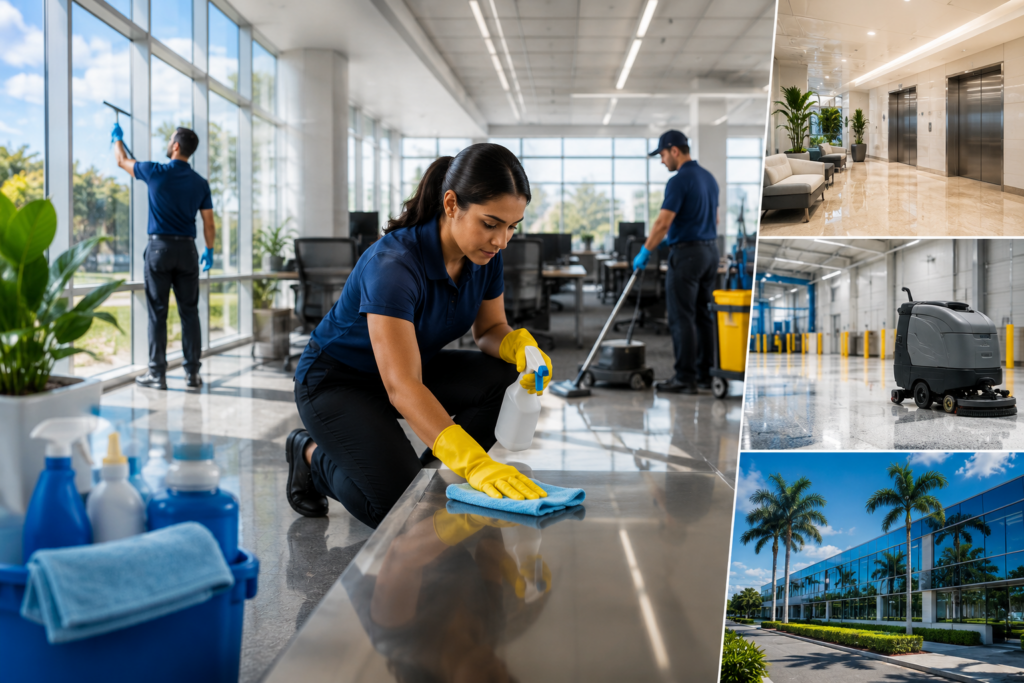
Commercial cleaning services cover the routine and deep-cleaning work that keeps offices, schools, restaurants, hotels, and other businesses healthy, presentable, and compliant.
For South Florida business owners and facility managers, you’re also facing high humidity, sand, and salt exposure, which makes cleaning a bit more complicated than it is for businesses in drier, less tropical climates.
But despite the added challenge that our climate brings, cleanliness is a must. A clean facility shapes how customers, patients, and employees feel the moment they walk through the door, and it plays a direct role in health, safety, and first impressions.
This guide breaks down what commercial cleaning services include, how often different facility types need them, the standards that keep South Florida businesses compliant, and what separates a dependable cleaning partner from one that cuts corners.
What Are Commercial Cleaning Services?
Commercial cleaning services refer to the professional cleaning and sanitation work performed in business and institutional settings, as opposed to private homes.
The scope is broad by design. A single cleaning company might handle daily trash removal and surface wiping for a small office, then turn around and manage a multi-stage deep clean for a large hospital wing.
What all these services have in common is the goal, which is keeping your facility safe, sanitary, and presentable for the people who work in it, visit it, or rely on it.
Most commercial cleaning falls into a few broad categories:
- Routine janitorial work
- Specialized deep cleaning
- Floor and surface restoration
- Facility-specific sanitation, such as medical-grade disinfection or food-service compliance
See the table below for a quick look at what types of businesses rely on commercial cleaning and why.
| Who Relies on It | What They Need | What’s At Stake |
| Businesses (offices, retail, hospitality) | Routine cleaning, day porter services, and cleanliness that makes a good first impression. | Appearance and hygiene shape customer trust and employee well-being. |
| Specialized Facilities (medical offices, schools, restaurants) | Disinfection protocols, regulatory compliance, and food-safety sanitation. | Health and safety regulations carry real legal and reputational repercussions if not adhered to. |
| Facility Managers | Scheduled deep cleaning, floor care, and construction cleanup. | Long-term asset protection and consistent, auditable cleaning standards. |
Whatever the setting, commercial cleaning companies bring training, equipment, and consistency that’s difficult to replicate with in-house staff alone.
Why Professional Commercial Cleaning Matters
The benefits of maintaining a clean facility go far beyond just looking good. You’re also protecting the people inside it. Employees who work in regularly sanitized spaces tend to take fewer sick days, and a workplace with poor sanitation can become a breeding ground for the kind of seasonal illness that quietly drains productivity.
High-touch surfaces like doorknobs, countertops, and handrails carry more shared contact than almost anywhere else in a building, which is exactly why routine surface cleaning matters in any space where dozens or hundreds of people pass through every day.
First impressions matter just as much. A prospective client touring an office, a patient sitting in a waiting room, or a diner walking into a restaurant forms an opinion of your business within seconds, and a dusty lobby or a streaked window undoes weeks of marketing in an instant.
Clean facilities build confidence and repeat business in a way that’s hard for customers to quantify, but easy for them to recognize when it’s missing.
There’s also a compliance layer to consider. OSHA’s sanitation standard sets minimum requirements for waste disposal, water supply, and workplace cleanliness, and businesses that fall short risk fines as well as the kind of workplace hazards that lead to injuries and lost time.
Add indoor air quality to the list, and the case for professional cleaning becomes less about preference and more about responsibility—to employees, to customers, and to the long-term health of the business itself.
Types of Commercial Facilities That Need Professional Cleaning
No two facilities will need the exact same cleaning services. A school clinic and a retail showroom face different risks, different traffic patterns, and different rules, and a strong cleaning partner adjusts methodology accordingly.
Here’s a look at ten facility types, common in South Florida, that depend on professional commercial cleaning daily.
Offices
Offices generate a steady churn of desks, shared equipment, break rooms, and conference spaces, all touched by the same group of people day after day. Routine vacuuming, trash removal, and disinfection of shared surfaces keep an office presentable for clients and comfortable for the staff who spend the bulk of their week there.
Schools
Schools combine high foot traffic with some of the most vulnerable populations a cleaning crew will ever serve. Classrooms, cafeterias, and restrooms all need disinfection protocols suited to children’s developing immune systems. Our School Cleaning and Disinfection Standards best practices breaks down exactly what that looks like, room by room.
Hotels
Hotels run on first impressions, and housekeeping standards shape guest reviews as much as decor does. Every room turnover, every lobby pass, and every poolside wipe-down adds up to the experience a guest remembers. Our Hotel Cleaning Best Practices covers what separates an average stay from a five-star one.
Restaurants
Restaurants answer to some of the strictest sanitation rules of any commercial setting, and Florida’s Division of Hotels and Restaurants conducts routine inspections to enforce them. Kitchens, dining rooms, and restrooms each carry distinct cleaning requirements tied directly to food safety.
Our Restaurant Cleaning Requirements in Florida guide walks through what local restaurant owners need to keep in place.
Churches
Churches serve congregations of every age, often across multiple services and community events in a single week. Sanctuaries, fellowship halls, and children’s wings all need attentive, respectful cleaning that keeps the space welcoming without disrupting its character.
Country Clubs
Country clubs blend dining rooms, locker rooms, fitness areas, and event spaces under one roof, each with its own upkeep demands. Members notice the details, from spotless glassware to immaculate locker rooms, and consistent cleaning protects that standard.
Municipal Buildings
City halls, libraries, and other municipal buildings serve a constant rotation of residents and employees alike. Public-facing spaces need reliable upkeep to maintain trust in local government, while back offices need the same routine attention as any business.
Medical Offices
Medical offices and hospitals carry some of the highest stakes of any commercial setting, with disinfection protocols designed to protect patients with compromised immune systems. Waiting rooms, exam rooms, and shared equipment all demand a higher standard of sanitation than a typical office.
Gyms and Fitness Centers
Gyms see constant skin contact with shared equipment, mats, and locker rooms, making them one of the places germs can spread fastest. Frequent disinfection of high-touch surfaces keeps members confident in the space and what they pay for membership each month.
Retail Stores
Retail stores depend on a clean, organized sales floor to keep customers browsing and buying. Fitting rooms, registers, and high-traffic entryways all need regular attention to maintain the polished look retail brands work hard to build.
What’s Included in Commercial Cleaning Services?
Commercial cleaning services typically fall into three segments: daily upkeep, weekly maintenance, and monthly deep cleaning. Each layer protects a different part of your facility, and together they form a complete office cleaning program that’s far more effective than a once-over with a vacuum.
Businesses looking for a detailed, room-by-room breakdown can find one in our Office Cleaning Checklist for Businesses guide, which lays out exactly what should happen and how often.
Daily Cleaning
Daily cleaning covers the tasks that keep a facility functional and sanitary from one day to the next:
- Emptying of trash and recycling bins before they overflow.
- Restrooms receive a full wipe-down, restock, and disinfection pass.
- Sanitizing of high-touch surfaces (door handles, light switches, and shared keyboards) to cut down on the spread of germs.
These tasks sound small individually, but skipping even one for a week turns a clean office into an uncomfortable, unsanitary one fast.
Weekly Cleaning
Weekly cleaning tackles the tasks that don’t need daily attention but still accumulate quickly if ignored:
- Carpets and hard floors get a full vacuum or mop.
- Spot-checking for wear, scuffs, or spills across floors that need immediate attention.
- Cleaning of windows and glass partitions to remove the smudges and fingerprints that build up over a busy week.
Skip these for even a few weeks, and the buildup turns into the kind of grime and wear that requires a full deep clean and disinfection service.
Monthly Deep Cleaning
Monthly deep cleaning is where the heavier equipment becomes necessary:
- Carpet extraction lifts dirt and allergens that vacuuming alone can’t reach.
- Hard floors may need stripping and rewaxing to restore shine and protect the surface underneath.
- High dusting for vents, light fixtures, the tops of cabinets, and shelving.
Staying on this monthly schedule protects your facility’s flooring investment and minimizes damage that’s visible to the naked eye. For a closer look at keeping carpets and hard floors in top condition between deep cleans, see our Commercial Floor Care Guide.
Commercial Cleaning vs Janitorial Services
Commercial cleaning and janitorial services often get used interchangeably, but they describe two different layers of facility upkeep.
Janitorial services handle the daily, routine tasks that keep a building running, such as trash removal, restroom upkeep, and basic surface cleaning, usually performed on a set schedule.
Commercial cleaning casts a wider net, covering periodic deep cleaning, specialized tasks like carpet extraction or floor restoration, and the kind of detailed sanitation that goes beyond daily janitorial upkeep.
| Commercial Cleaning | Janitorial Services |
| Deep cleaning | Ongoing maintenance |
| Periodic service | Daily service |
| Specialized tasks | Routine tasks |
Most businesses need both. Janitorial services keep your facility presentable day to day, while commercial cleaning helps you stay compliant with sanitation regulations and standards.
A facility relying only on daily janitorial work without periodic deep cleaning will eventually build up grime and germs that require heavy-duty equipment, chemicals, and cleaning crews.
For a full breakdown of where one ends and the other begins, see our Commercial Cleaning vs Janitorial Services guide.
How Often Should Commercial Properties Be Cleaned?
Cleaning frequency depends heavily on your facility type, foot traffic, and what’s at stake if cleanliness slips. An administrative back office can often get by with a lighter weekly schedule, while a restaurant kitchen needs attention multiple times throughout a single shift.
See the table below for basic guidelines.
| Facility | Recommended Frequency |
| Office | Daily / Weekly |
| School | Daily |
| Restaurant | Daily |
| Hotel | Daily |
| Gym | Multiple times daily |
But to be clear, these are starting benchmarks, not hard requirements. A high-traffic office near a busy South Florida tourist corridor may need daily attention, even if a similar office in a quieter location could stretch to a few times a week.
The right frequency comes down to occupancy, the type of work performed on-site, and any regulatory requirements specific to the industry.
For a closer look at how to build a cleaning schedule around a specific facility type, our How Often Should Commercial Buildings Be Cleaned? guide goes deeper into each category above.
Commercial Cleaning Standards and Best Practices
Commercial cleaning works best when it follows established standards rather than guesswork. High-touch surfaces deserve particular attention, since the CDC’s guidance on respiratory illness prevention identifies regular cleaning of shared surfaces as one of the most effective, low-cost ways to slow the spread of common illnesses through a building.
Restrooms carry their own set of standards entirely, covered in depth in our Commercial Restroom Cleaning Standards guide.
Green cleaning has moved from a niche request to a standard expectation in many South Florida facilities, particularly schools, healthcare offices, and any business with employees or visitors sensitive to harsh chemicals.
The EPA’s Safer Choice program certifies cleaning products that meet strict safety standards without sacrificing performance, which gives your facility managers a reliable way to vet products before they’re approved for use on-site.
Contact us today to learn how Rainbow Spectrum Cleaning commercial cleaning will work with you to design a program that meets both your facility’s needs and current EPA guidance.
Lastly, across all the other best practices and standards that professional cleaners follow, cross-contamination prevention guarantees maximum safety. Color-coded cloths and mop heads, separate equipment for restrooms versus common areas, and consistent staff training all reduce the risk of spreading bacteria from one part of a facility to another.
Common Commercial Cleaning Mistakes Businesses Make
Even well-meaning businesses fall into a handful of common traps when managing facility cleanliness.
- Hiring based on price alone — The cheapest bid rarely accounts for proper training, insurance, or consistent staffing.
- Inconsistent cleaning schedules — Skipping weeks during slow periods lets dirt and grime build up faster than a single deep clean can fix.
- Ignoring high-touch surfaces — Daily wipe-downs often miss door handles, light switches, and shared equipment.
- Poor restroom maintenance — Restrooms shape a visitor’s overall impression of a facility more than almost any other space.
- No cleaning documentation — Facilities without a paper trail of completed tasks have no way to verify consistency or address gaps.
Avoiding these pitfalls comes down to choosing a cleaning partner who treats accountability as part of the job, not an afterthought.
How to Choose the Right Commercial Cleaning Company
Choosing a commercial cleaning company is as much about trust as it is about price. A few criteria separate dependable partners from the rest:
- Experience — A company with decades of work across varied facility types has already solved problems a newer company hasn’t encountered yet.
- Insurance — Proper liability coverage protects a business from the financial fallout of an on-site accident or damage.
- Training — Staff who understand proper chemical handling, equipment use, and safety protocols deliver more consistent results.
- Industry specialization — A company experienced in a specific facility type, whether that’s a school or a hotel, understands the unique standards that apply.
- Reviews — Feedback from other South Florida businesses offers a clearer picture than any sales pitch.
- Quality control systems — Regular inspections and accountability measures catch problems before they become client complaints.
- Local presence — A company rooted in the community will know exactly how to tackle South Florida’s specific cleaning challenges, rather than applying a one-size-fits-all approach.
The right partner brings all seven of these factors to the table, not just one or two. By asking pointed questions about each of these areas before signing a contract, you put your business in a much stronger position than by simply comparing quotes.
If you’re ready to get started or learn more, contact Rainbow Spectrum Cleaning today for your quote and site assessment.
Why South Florida Businesses Face Unique Cleaning Challenges
As a South Florida business, you’re up against several climate demands that businesses in drier regions rarely have to consider.
According to NOAA’s climate data, our region’s subtropical climate brings hot, humid summers with frequent afternoon thunderstorms, conditions that create near-constant opportunities for mold and mildew to take hold in poorly maintained spaces.
Meanwhile, air conditioning systems that run nearly year-round add another item to the list, since indoor air quality depends heavily on how well a facility manages dust, moisture, and ventilation.
Sand and salt exposure present their own headaches, particularly for businesses near the coast. Tracked-in sand wears down flooring faster than it would inland, and salt air can corrode fixtures and signage over time without regular cleaning and maintenance.
Hurricane season adds its own cleanup demands, from storm debris to the post-storm humidity that accelerates mold growth if a facility isn’t addressed quickly.
Finally, don’t forget about this area’s year-round tourism traffic. Hotels, restaurants, and retail spaces across Jupiter, Palm Beach County, Broward County, Martin County, and St. Lucie County see consistent foot traffic that doesn’t slow down for an off-season the way it might elsewhere.
With 35+ years of experience cleaning commercial spaces throughout this exact region, our team at Rainbow Spectrum Cleaning custom-builds South Florida commercial cleaning schedules around this reality rather than relying on generic routines designed for cooler, drier markets.
When Should a Business Hire a Professional Commercial Cleaning Company?
Several specific signs indicate your facility would benefit from hiring a professional commercial cleaning company. It may be time for you to bring in a dedicated cleaning partner if:
- The size of your workforce is now larger than what your in-house cleaners can handle on a daily basis.
- You have multiple locations that need a consistent, universal cleaning standard for every single site.
- It’s becoming harder for your staff to stay on par with industry regulations and requirements, such as healthcare or food service.
- A seasonal uptick in illness or a specific health concern is impacting your employees and customers.
- Recent construction or renovation work that has left dust and debris behind.
Recovering from construction or renovation work calls for a particularly specialized approach, since fine dust and debris settle into places a standard cleaning routine isn’t built to reach.
Our Post Construction Cleaning Checklist walks through exactly what that process should include, from initial debris removal to the lingering dust that surfaces long after the crew has left.
Frequently Asked Questions About Commercial Cleaning Services
How much do commercial cleaning services cost?
Commercial cleaning costs vary based on facility size, cleaning frequency, and the specific services required. Most companies price by square footage, with additional charges for specialized tasks like floor stripping or deep disinfection. Factors that affect cost include:
- Facility type and square footage
- Cleaning frequency (daily, weekly, monthly)
- Specialized services like carpet extraction or construction cleanup
A site assessment is the most reliable way to get an accurate quote for a specific facility.
What’s the difference between commercial cleaning and janitorial services?
Janitorial services cover daily, routine maintenance like trash removal and basic surface cleaning. Commercial cleaning includes those tasks but also covers periodic deep cleaning, specialized work like floor restoration, and facility-specific sanitation needs.
Most businesses benefit from both of these working together rather than choosing one over the other. See our Commercial Cleaning vs Janitorial Services guide for a full comparison.
Are commercial cleaning services tax-deductible?
Commercial cleaning services are generally considered a deductible business operating expense for companies that lease or own commercial space, similar to other facility maintenance costs. Deductibility can depend on how a business is structured and how the expense is categorized.
Business owners should consult a qualified tax professional or accountant to confirm how commercial cleaning expenses apply to their specific situation.
Do commercial cleaning companies provide supplies?
Most commercial cleaning companies supply their own cleaning products, equipment, and disinfectants as part of the service agreement. This typically includes:
- Cleaning chemicals and disinfectants
- Vacuums, mops, and specialized equipment
- Restroom and break room supplies like paper products and soap
That said, you should confirm exactly what’s included before signing a contract, since supply arrangements can vary between providers.
How do I choose a commercial cleaning company?
Look for a company with proven experience in a specific facility type, proper insurance coverage, and trained staff. Other key factors include:
- Strong local reviews and references
- A documented quality control process
- Local presence and familiarity with regional cleaning challenges
A company that can speak confidently to all of these areas is generally a safer choice than one that only has competitive prices.
Can commercial cleaners work after business hours?
Yes, most commercial cleaning companies offer daytime and nighttime service options, including cleaning outside of regular business hours. After-hours cleaning minimizes disruption to employees and customers and allows for tasks like floor stripping or deep disinfection that work better in an empty facility.
Businesses should discuss scheduling needs directly with their cleaning provider to find the best arrangement.
What industries require professional commercial cleaning?
Nearly every industry benefits from professional cleaning, though some carry stricter requirements than others. Common industries include:
- Offices, retail, and municipal buildings
- Schools and educational facilities
- Healthcare and medical offices
- Restaurants and food service
- Hotels and hospitality
Industries with health or safety regulations, like healthcare and food service, generally require more frequent and specialized cleaning protocols.
Are green cleaning products available?
Yes, many commercial cleaning companies offer green cleaning programs using products certified under the EPA’s Safer Choice program, which verifies cleaning performance alongside safety for people and the environment. If you operate a school, healthcare clinic, or facility with chemical-sensitive occupants, we encourage you to request these programs.
Ready for a Cleaner, Healthier Facility?
For 35+ years, Rainbow Spectrum Cleaning has provided commercial cleaning services to businesses across South Florida. As a family-owned, second-generation company, we bring the kind of consistency and accountability that comes from truly caring about the spaces we maintain, just as much as you do.
Our services include general janitorial cleaning, custom cleaning solutions, daytime and nighttime service, deep cleaning and disinfecting, day porter and housekeeping, construction cleaning, emergency cleaning services, and marble and stone restoration, with no job too big or too small.
We proudly serve Palm Beach County from Jupiter, Palm Beach Gardens, West Palm Beach, Wellington down to Boca Raton, Martin County from Stuart to Tequesta, St. Lucie County from Port St. Lucie to Fort Pierce, and Broward County from Deerfield, Fort Lauderdale down to Hallandale Beach.
Ready to see what professional commercial cleaning services can do for your facility? Contact Rainbow Spectrum Cleaning today or call us at (561) 743-7424 to schedule your consultation and site assessment.