
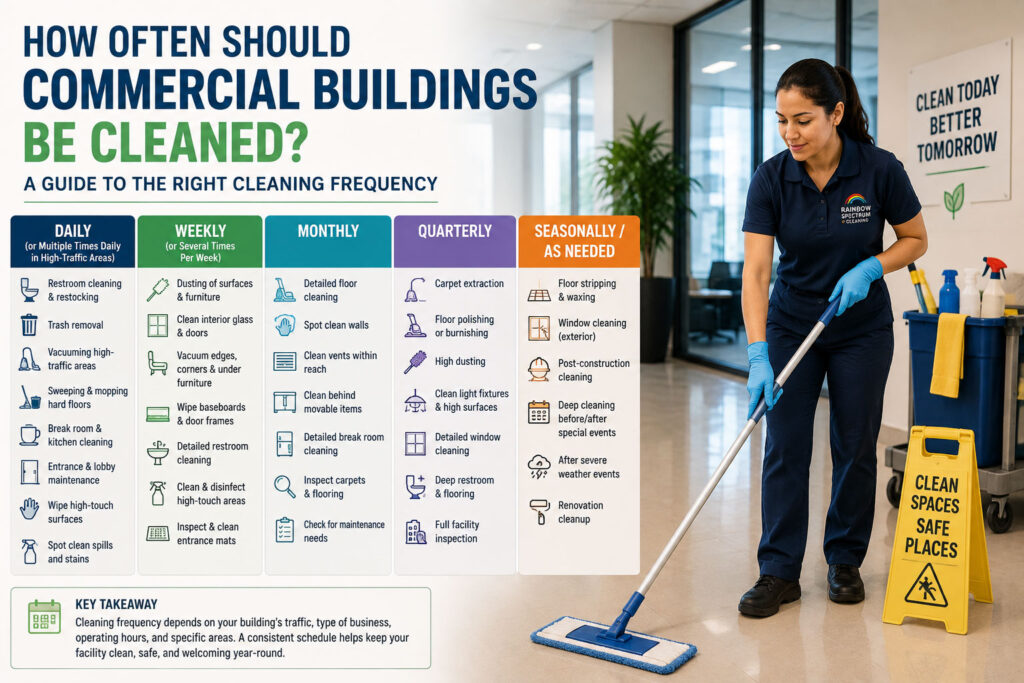
Commercial buildings should be cleaned according to how the facility is used, how much foot traffic it receives, the number of employees and visitors, the type of business, and the condition of its floors, restrooms, common areas, and other high-use spaces.
There is no single cleaning schedule that works for every business.
Some facilities require daily cleaning. Others may only need professional service several times per week. Deep-cleaning tasks such as carpet extraction, floor polishing, high dusting, and window cleaning are usually scheduled less frequently.
For most businesses, the best approach combines routine janitorial cleaning with periodic commercial deep cleaning.
For a broader overview of professional facility maintenance, see our Ultimate Guide to Commercial Cleaning Services in South Florida.
What Determines How Often a Commercial Building Should Be Cleaned?
Cleaning frequency should be based on the actual conditions inside the building rather than a generic schedule.
Several factors influence how often a commercial property should be professionally cleaned.
Foot Traffic
The more people who enter a building, the more frequently floors, entrances, restrooms, and common areas typically need attention.
A busy hotel, school, restaurant, medical office, municipal building, or country club may require significantly more frequent cleaning than a small professional office.
Number of Employees
More employees usually means:
- More trash
- More restroom use
- More break room use
- More floor traffic
- More frequently touched surfaces
- More activity in common areas
A large office may therefore need daily cleaning even if customers rarely enter the building.
Customers and Visitors
Businesses that regularly receive customers, patients, guests, students, members, or members of the public often require more frequent cleaning.
Presentation also becomes more important in customer-facing environments.
Type of Facility
Different facilities have different priorities.
An office may focus heavily on workspaces, restrooms, conference rooms, and break rooms.
A school may require frequent attention to classrooms, hallways, floors, and restrooms.
A hotel may prioritize entrances, lobbies, corridors, public restrooms, and other guest-facing areas.
Type of Flooring
Flooring also affects cleaning frequency.
Carpeted areas may require frequent vacuuming and periodic extraction.
Hard floors may need routine sweeping and mopping along with periodic machine cleaning, polishing, or other maintenance.
Operating Hours
A building operating five days per week may have different needs than a facility open seven days a week.
Businesses with long operating hours or multiple shifts may require more frequent service.
What Commercial Cleaning Tasks Should Be Done Daily?
Daily cleaning is generally appropriate for areas that receive heavy use or need to remain consistently presentable.
Common daily cleaning tasks include:
- Emptying trash
- Replacing trash liners
- Cleaning restrooms
- Restocking restroom supplies
- Vacuuming high-traffic carpets
- Sweeping hard floors
- Mopping hard floors
- Cleaning break rooms
- Wiping common high-touch surfaces
- Cleaning entrances
- Removing visible debris
- Cleaning reception and waiting areas
- Spot cleaning glass
Not every commercial building requires every task every day.
A small office with limited staff may only need professional cleaning several times per week. A busy restaurant, hotel, school, or municipal facility may need some areas cleaned multiple times throughout the day.
The goal is to match the schedule to the amount of use.
What Should Be Cleaned Several Times Per Week?
For many offices and lower-traffic commercial properties, several-times-per-week cleaning provides a practical middle ground.
Tasks may include:
- Vacuuming
- Mopping
- Trash removal
- Dusting
- Restroom cleaning
- Break room cleaning
- Common-area cleaning
- Entrance maintenance
- Interior glass spot cleaning
A professional office that operates Monday through Friday, for example, may not require a full cleaning every day if the staff is small and visitor traffic is limited.
However, restrooms, trash, or entrance areas may still need more frequent attention.
This is why a cleaning plan should be divided by area rather than assigning one frequency to the entire building.
What Commercial Cleaning Tasks Should Be Done Weekly?
Weekly cleaning can address details that are important but may not need attention during every visit.
Common weekly tasks include:
- Detailed dusting
- Cleaning window sills
- Wiping doors and frames
- Cleaning interior glass
- Vacuuming edges and corners
- Cleaning under accessible furniture
- Cleaning low ledges
- Detailed break room cleaning
- Detailed restroom cleaning
- Spot cleaning walls
- Cleaning furniture surfaces
The appropriate frequency depends on traffic.
Some high-use facilities may need these tasks performed several times per week or even daily.
What Should Be Cleaned Monthly?
Monthly commercial cleaning is often focused on areas that require more detailed attention than routine janitorial service provides.
Examples may include:
- Detailed baseboard cleaning
- Higher-level dusting
- Detailed interior glass cleaning
- Cleaning doors and frames
- Spot cleaning carpets
- Detailed floor inspection
- Cleaning difficult-to-reach corners
- Cleaning behind movable furniture
- Evaluating carpet wear
- Inspecting floor finish
- Detailed restroom cleaning
- Cleaning vents within safe reach
Monthly cleaning is also a useful opportunity to evaluate whether any areas require deeper professional service.
For a more detailed task breakdown, see our Commercial Cleaning Checklist for Businesses.
What Commercial Cleaning Should Be Done Quarterly?
Quarterly cleaning is often used for deeper work that does not need to be performed during routine maintenance visits.
Depending on the facility, quarterly services may include:
- Carpet extraction
- Floor polishing
- High dusting
- Detailed window cleaning
- Deep restroom cleaning
- Detailed entrance cleaning
- Cleaning elevated ledges
- Deep cleaning common areas
- Machine floor cleaning
- Detailed cleaning of lower-traffic areas
Some businesses may need these services more frequently.
For example, heavily traveled carpet may need professional extraction more often than carpet in a low-use office.
Similarly, floors in a hotel lobby, school hallway, restaurant, or country club may require more frequent maintenance than floors in a small office.
What Cleaning Tasks Should Be Done Annually or Seasonally?
Certain commercial cleaning projects are typically performed seasonally or when conditions indicate they are needed.
These may include:
- Floor stripping and waxing
- Major carpet cleaning
- High dusting
- Large-scale window cleaning
- Deep facility cleaning
- Cleaning after renovations
- Post-construction cleanup
- Cleaning before or after major events
- Seasonal floor restoration
- Cleaning difficult-to-access areas
An annual schedule should not be treated as a strict rule.
If an area becomes worn or visibly dirty sooner, it should be cleaned sooner.
Likewise, a low-traffic area may not require certain deep-cleaning services every year.
Commercial Cleaning Frequency by Area
Different areas of a commercial building usually require different schedules.
| Area | Suggested Frequency |
|---|---|
| Entrances | Daily or several times per week |
| Restrooms | Daily or multiple times daily in high-traffic facilities |
| Trash | Daily or as needed |
| Break Rooms | Daily or several times per week |
| Offices | Several times per week or based on use |
| Conference Rooms | Several times per week or after heavy use |
| Hallways | Daily or several times per week |
| Common Areas | Daily or several times per week |
| Carpets | Vacuum frequently; deep clean periodically |
| Hard Floors | Sweep/mop frequently; deep clean periodically |
| Interior Glass | Weekly or as needed |
| High Dusting | Quarterly or periodically |
| Windows | Periodically based on appearance |
| Floor Restoration | As needed based on condition |
These are general guidelines.
The actual schedule should be adjusted based on the facility.
How Often Should Office Buildings Be Cleaned?
Office buildings commonly need professional cleaning anywhere from several times per week to daily.
A typical office cleaning program may include:
Daily or Several Times Per Week
- Empty trash
- Vacuum
- Mop hard floors
- Clean restrooms
- Clean break rooms
- Maintain entrances
- Clean common areas
Weekly
- Detailed dusting
- Interior glass cleaning
- Edge vacuuming
- Detailed restroom cleaning
Monthly or Quarterly
- Carpet cleaning
- Floor maintenance
- Higher dusting
- Window cleaning
- Deeper facility cleaning
The number of employees and visitors is one of the biggest factors.
See our Office Cleaning Services for more information.
How Often Should Schools Be Cleaned?
Schools generally require frequent cleaning because of the number of students, teachers, staff members, and visitors using the building.
Areas that may require daily attention include:
- Classrooms
- Hallways
- Restrooms
- Administrative areas
- Cafeterias
- Entrances
- High-traffic floors
- Common areas
Deeper cleaning can often be scheduled during weekends, school breaks, or seasonal closures.
See our School Cleaning Services.
How Often Should Hotels Be Cleaned?
Hotels typically require continuous attention to guest-facing and common areas.
These may include:
- Entrances
- Lobbies
- Public restrooms
- Corridors
- Elevators
- Meeting spaces
- Common floors
- Glass surfaces
High-traffic areas may need cleaning multiple times per day.
Periodic commercial cleaning can include carpet extraction, detailed floor maintenance, high dusting, and deeper cleaning of public spaces.
See our Hotel Cleaning Services.
How Often Should Restaurants Be Cleaned?
Restaurants generally require frequent cleaning because of continuous customer traffic and food-service activity.
Dining areas, entrances, floors, restrooms, employee spaces, and frequently touched surfaces may need daily attention.
Some areas may require cleaning throughout the day depending on traffic.
Periodic deeper cleaning can help maintain floors, glass, hard-to-reach areas, and other surfaces beyond routine cleaning.
See our Restaurant Cleaning Services.
How Often Should Churches Be Cleaned?
Church cleaning frequency often depends on the schedule of services and events.
A church may require cleaning:
- Before or after weekly services
- After weddings
- After funerals
- After meetings
- Before holidays
- After large community events
Routine janitorial cleaning may be combined with quarterly or seasonal deep cleaning.
See our Church Cleaning Services.
How Often Should Country Clubs Be Cleaned?
Country clubs can require frequent cleaning because they combine multiple types of spaces within one facility.
These may include:
- Dining areas
- Member areas
- Restrooms
- Event spaces
- Offices
- Entrances
- Common areas
- High-traffic flooring
Recurring janitorial cleaning may be performed daily or several times per week, while carpet cleaning, floor care, high dusting, and other deeper work may be scheduled periodically.
See our Country Club Cleaning Services.
How Often Should Municipal Buildings Be Cleaned?
Municipal buildings may receive significant public traffic throughout the workweek.
Cleaning may be required daily for:
- Restrooms
- Public counters
- Waiting areas
- Hallways
- Entrances
- Offices
- Meeting rooms
- Common spaces
Periodic deep-cleaning services may also be necessary depending on traffic and the condition of the building.
See our Municipal Cleaning Services.
South Florida Cleaning Frequency Considerations
Commercial buildings in South Florida may need cleaning schedules adjusted for local conditions.
Rain
Frequent rain can bring water, dirt, and debris into entrances.
During rainy periods, entrance floors and mats may need additional attention.
Sand
Sand can be tracked into offices, hotels, restaurants, country clubs, schools, and other buildings.
Vacuuming and floor maintenance may need to occur more frequently in affected areas.
Humidity
South Florida’s high humidity makes consistent facility maintenance especially important.
Areas exposed to moisture or poor airflow should be regularly inspected and maintained.
Seasonal Traffic
Tourism and seasonal residents can increase traffic at hotels, restaurants, country clubs, medical offices, retail properties, and other facilities.
Cleaning schedules may need to increase during busier periods.
Severe Weather
Storm preparation, repairs, and cleanup can create temporary cleaning needs beyond the normal schedule.
Businesses may require additional commercial cleaning following maintenance, construction, renovation, or weather-related work.
Routine Janitorial Cleaning vs. Periodic Commercial Cleaning
One of the best ways to structure a facility maintenance program is to divide work into two categories.
Routine janitorial cleaning may include:
- Trash removal
- Vacuuming
- Mopping
- Restroom cleaning
- Break room cleaning
- Dusting
- Common-area cleaning
Periodic commercial cleaning may include:
- Carpet extraction
- Floor polishing
- Floor stripping and waxing
- High dusting
- Window cleaning
- Detailed deep cleaning
- Post-construction cleaning
Businesses often benefit from both.
For a more detailed explanation, see Commercial Cleaning vs. Janitorial Services: What’s the Difference?
How Do You Know If Your Building Needs More Frequent Cleaning?
There are several signs that a cleaning schedule may need to be increased.
These include:
- Trash regularly fills before the next service
- Restrooms become visibly dirty between visits
- Floors look worn or dirty soon after cleaning
- Entrances accumulate sand or debris
- Employees report cleanliness concerns
- Common areas become untidy between visits
- Carpet traffic lanes become visible
- Customer-facing areas do not remain presentable
- Business traffic has increased
- The facility’s operating hours have expanded
A cleaning schedule should be flexible.
As traffic or occupancy changes, cleaning frequency should change with it.
How to Create the Right Cleaning Schedule
Start by dividing the facility into individual areas.
Then determine:
- How many people use each area
- How quickly it becomes dirty
- Whether it is customer-facing
- Whether food is present
- Whether it contains a restroom
- What type of flooring is installed
- Whether it requires specialized equipment
- Whether cleaning can occur during business hours
Each task can then be assigned a frequency such as:
- Daily
- Several times per week
- Weekly
- Monthly
- Quarterly
- Seasonal
- As needed
A professional commercial cleaning company can help turn that information into a practical scope of work.
Learn more about the broader service in What Is Commercial Cleaning?
Frequently Asked Questions About Commercial Cleaning Frequency
Should a commercial building be cleaned every day?
Not every commercial building requires daily professional cleaning. The appropriate frequency depends on traffic, facility size, number of employees, customers or visitors, restrooms, operating hours, and how quickly spaces become dirty. High-traffic facilities commonly need daily cleaning, while smaller offices may only require service several times per week.
How often should commercial restrooms be cleaned?
Commercial restrooms should generally be cleaned frequently enough to remain clean, stocked, and presentable throughout operating hours. Many businesses require daily restroom cleaning, while heavily used facilities such as schools, hotels, restaurants, and public buildings may need restroom checks and cleaning multiple times during the day.
How often should commercial carpets be cleaned?
Commercial carpets should be vacuumed regularly and professionally deep cleaned according to traffic and condition. High-traffic entrances, corridors, offices, hotels, and public spaces may need carpet extraction more frequently than low-use areas. The appropriate schedule should be based on visible wear, soil buildup, and facility use.
How often should commercial floors be deep cleaned?
Deep floor cleaning frequency depends on the flooring material, traffic, and appearance standards. Some floors may need machine cleaning or polishing monthly or quarterly, while stripping and waxing or other restorative services may be performed less frequently. High-traffic facilities often require more frequent floor maintenance.
How often should office buildings be professionally cleaned?
Many office buildings are professionally cleaned several times per week or daily. The appropriate schedule depends on employee count, visitors, facility size, restrooms, break rooms, flooring, and operating hours. Larger or busier offices generally require more frequent service than small professional offices.
Should commercial buildings receive seasonal deep cleaning?
Many commercial properties benefit from periodic or seasonal deep cleaning. This can include carpet extraction, floor maintenance, high dusting, window cleaning, detailed restroom cleaning, and other tasks that are not typically performed during routine janitorial visits. The schedule should reflect traffic and building conditions.
Can a commercial cleaning schedule change during the year?
Yes. Cleaning schedules should be adjusted when facility usage changes. Seasonal tourism, increased staffing, special events, school calendars, business growth, renovations, severe weather, or changes in operating hours can all increase or decrease cleaning needs.
How do I determine the right cleaning frequency for my business?
Evaluate each area of your facility based on traffic, use, flooring, restrooms, employee count, visitors, operating hours, and how quickly the area becomes dirty. Assign daily, weekly, monthly, quarterly, or as-needed frequencies to individual tasks. An on-site professional cleaning assessment can help establish a more precise schedule.
Create the Right Commercial Cleaning Schedule for Your Facility
There is no universal answer to how often a commercial building should be cleaned.
A small office may only require professional cleaning several times per week, while a busy school, hotel, restaurant, country club, medical office, or municipal building may require daily service and additional cleaning throughout the day.
The most effective cleaning plan combines routine maintenance with periodic deeper cleaning based on the actual use and condition of the property.
Rainbow Spectrum Cleaning works with offices, schools, hotels, restaurants, churches, country clubs, municipal facilities, and other commercial properties throughout South Florida.
If you are unsure how often your facility should be professionally cleaned, request a proposal. A walkthrough can help determine the right cleaning frequency for each area of your property.